Solutions
Retention
AI
Built-in, sovereign AI
Cards and AI
Create, repurpose, challenge and steer skills development.
Works with your AI
Claude
ChatGPT
Mistral AI
Copilot
Perplexity
Dust
Home / Training / Upskilling and reskilling
Upskilling strengthens an employee’s skills in their current job; reskilling prepares them for a new role. With Cards, both rely on short courses tied to job requirements, sequenced in a 10- to 30-day Learning Routine® with automatic reminders, role-plays and self-assessments. Teams progress without blocking out entire days, each profile gets what it needs, and HR tracks completion, retention and feedback to measure time-to-skill on key skills.

Skills change as fast as technology, and many companies struggle to roll out upskilling that truly works:
Learning paths that are too long and don’t fit frontline constraints
Learner engagement that fades over time
Training ROI that is hard to measure
Skills that rarely carry over to the job
And yet the stakes are strategic: maintaining employability, supporting job transitions and upskilling teams faster and at lower cost.
Agility, clear objectives and grounding in day-to-day work: that’s what separates a completed course from an acquired skill.
Reskilling and upskilling are the 2nd most anticipated L&D topic for 2026, with 10.5% of votes in Donald H. Taylor's L&D Global Sentiment Survey (3,797 respondents, 105 countries). According to the ISTF 2026 survey, the top lever for getting an employee to start a course is still content tied to their job challenges (16%), on par with dedicated time. Hence short courses, linked to what each role requires.
✓Capsules built directly around job requirements
✓New tools, processes or soft skills
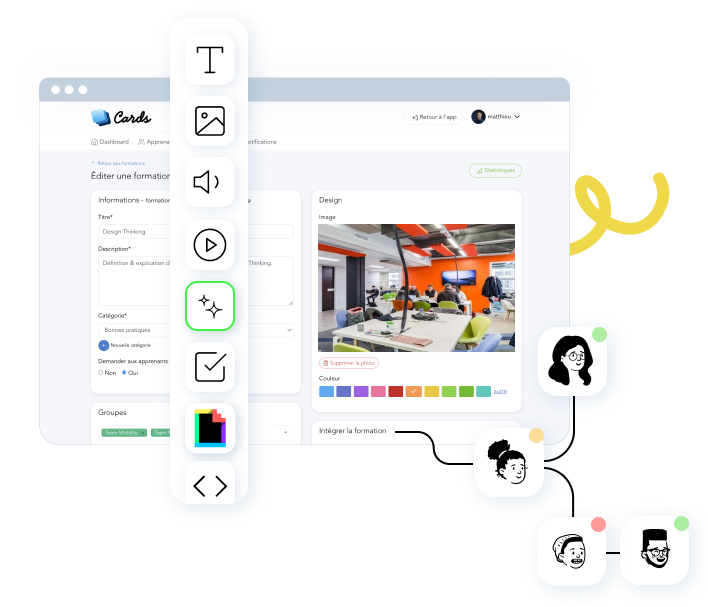
✓Faster design with the authoring tool and built-in AI
✓10- to 30-day retention routine with automatic reminders
✓Learning paths personalized by profile and self-assessment
✓Lasting habits without cognitive overload (see the engine)
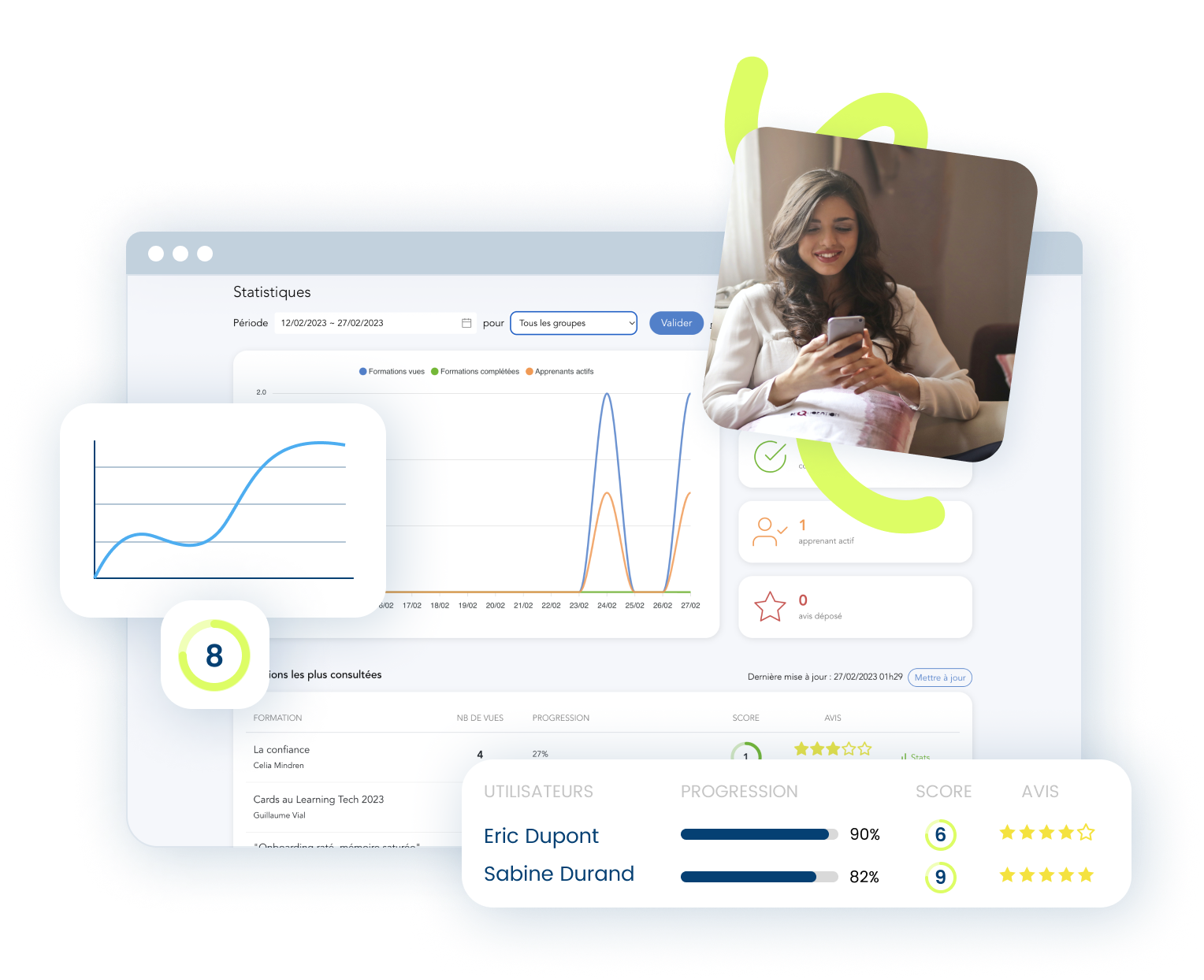
✓Completion, retention and feedback tracked in the dashboard
✓Content adjusted and HR actions prioritized based on results
✓Skills validated and mapped (Skills)

Goal: master a new CRM tool or a soft skill (time management, feedback). Here is the routine as it is built in Cards.
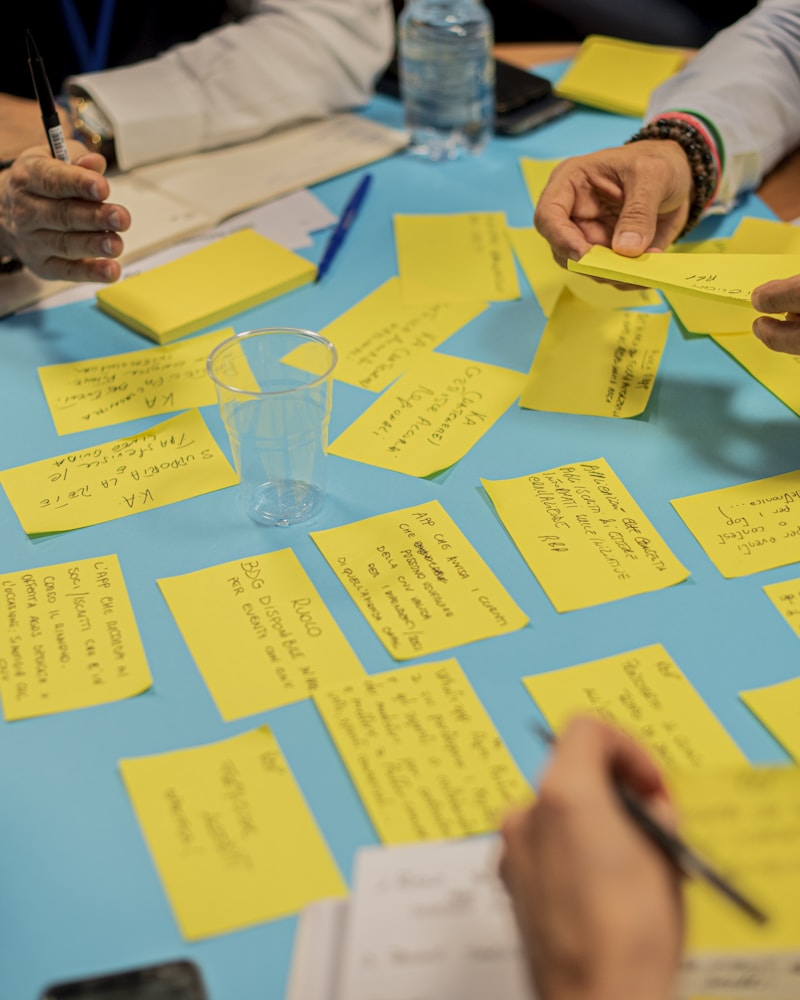







Customizable example: the same logic applies to reskilling for a new job, with a longer routine and more hands-on steps. Results feed into skills mapping.
Short content, the right pace, measurable impact.
Each profile follows a learning path suited to its level and goals.
Short, practical formats that fit into the workday.
Fast creation, reuse of existing materials and AI assistance.
Customer reviews
Our customers explain how Cards streamlined their workflows and boosted retention without negatively impacting their teams' wellbeing or productivity




More than 200 companies trust us, for nearly 100,000 users worldwide.

Déborah G.
My English School France
Anna
My Learning Store

Véronique
Naos

Nicolas B.
Training Consultant

Ludovic A.
First Aid Trainer
What HR directors and training managers ask us before launching their upskilling programs.
Upskilling develops an employee’s skills in their current job. Reskilling trains them for a new job or role. Both benefit from a short format repeated over time.
Between 10 and 30 days for a targeted skill, like the 3-week example on this page. Reskilling requires a longer routine, broken down into several skills.
With Learning Routine® conditions: based on a self-assessment or a quiz result, each learner receives targeted catch-up content or moves straight to the next step.
By tracking completion, quiz results and skill validation in the dashboard, with exports for your HR reports.
Yes. Your materials (PDFs, presentations, SCORM modules) can be turned into short courses with the built-in AI, then used in a retention routine.
To build your teams' skills over the long term, combine skills mapping, the learning anchoring cycle and blended formats that extend in-person training.
Have a question? Find quick answers in our FAQ.
In 30 minutes, we’ll show you an upskilling routine in Cards, built on a use case close to yours.
Worth reading:
The complete guide
to impactful microlearning.


Create short, memorable courses in no time.