On 2 August 2026, something changes for every company that uses AI.
Not in a year. Not just for the tech giants. In a matter of days, and for everyone.
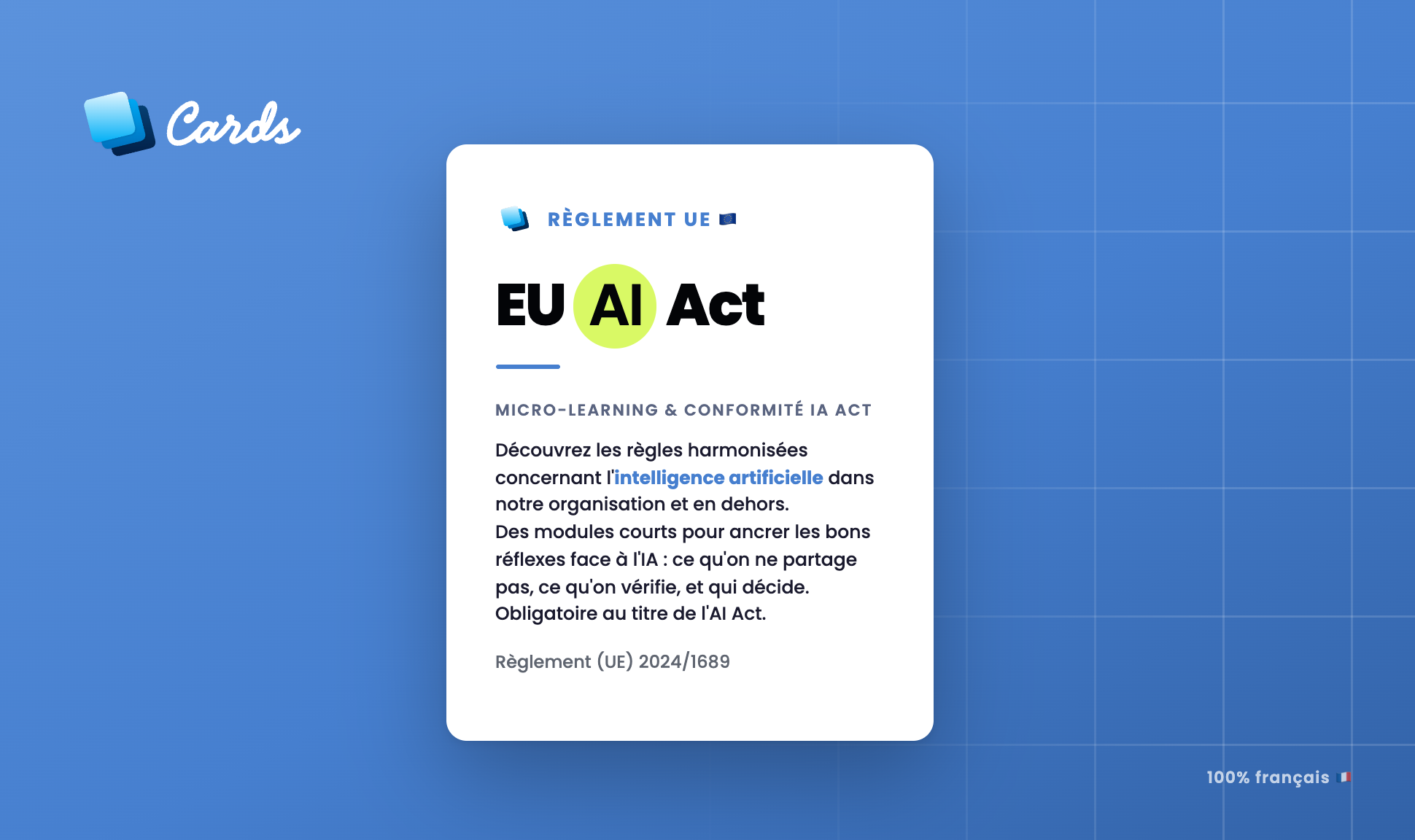
On that date, national authorities, led by the CNIL in France, gain the power to monitor and sanction an obligation that already exists but that most organizations never noticed: Article 4 of the EU AI Act, the AI literacy requirement.
Here is what the text really says. What it doesn't. And why, for once, ticking the box won't be enough.
What Article 4 actually says
Article 4 of the EU AI Act (Regulation 2024/1689) has been in force since 2 February 2025. It requires every provider and every deployer of an AI system to ensure a sufficient level of AI literacy among their staff.
Three points many leaders still miss.
No headcount threshold. A five-person company writing its quotes with ChatGPT is covered exactly like a large group.
No prescribed format. The text calls for appropriate measures, proportionate to role, tools and risk. Awareness sessions, workshops, learning routines: all acceptable, as long as the approach is documented.
An obligation of result. Not we ran a training. But we can demonstrate that our teams use AI in an informed, responsible way.
So what changes on 2 August 2026 is not the obligation itself. It is the moment regulators can come and check.
What the text does not say (and what you're being sold too quickly)
You may have seen alarming numbers. 7.5 million euros. 15 million. 3% of global revenue.
Let's be precise, because precision is the first form of seriousness.
There is no specific fine attached to Article 4. The ceilings circulating are the AI Act's general penalty tiers: up to 35M€ or 7% of revenue for prohibited practices, up to 15M€ or 3% for other breaches, 7.5M€ or 1.5% for incorrect information given to authorities.
In practice, failing the AI literacy duty acts mostly as an aggravating factor. Untrained teams don't automatically trigger a fine. But they weaken your position on everything else: human oversight, risk management, uncontrolled usage.
The real threat isn't a line in a penalty grid. It's the day an AI-related incident reveals that nobody in your company had been trained to use it.
The real trap: training is not proving
Picture the classic scene. A one-day session. A slide deck. A signed attendance sheet. Box ticked.
Three weeks later, 70% of the content is gone. That's Ebbinghaus's forgetting curve, and it makes no exception for compliance.
You end up with the worst of both worlds: a spent budget, fragile proof, and employees using AI exactly as before.
Surface compliance is theatre. The regulator asks for real, lasting mastery. Not a photo taken one Tuesday in July.
Checklist: standing on solid ground for Article 4
- Map the real AI usage across the company, including undeclared tools.
- Segment by profile: occasional user, regular business user, power user or decision-maker. The bar isn't the same.
- Train with short, concrete content tailored to each role.
- Document: materials, participants, dates, assessments. Traceability is the proof.
- Sustain it over time. AI literacy isn't an event, it's a reflex to reactivate.
Where anchoring becomes your best proof
This is exactly where impactful microlearning changes the game.
Rolling out an AI literacy routine to the whole organization in a few days answers the calendar's urgency.
But the point is elsewhere. Cards's Learning Routine® engine doesn't just push content. It reactivates it at the right moment, measures what sticks, and leaves a living trace of literacy over time.
In other words: anchoring becomes the evidence. Not the ticked box, but the demonstration that your teams know, and keep knowing.
Everyone will train on AI before 2 August. Proving it has been anchored is what the regulator will really ask for.
This article offers an operational reading of Article 4 of the EU AI Act. It is not legal advice: for an analysis of your situation, please consult your usual counsel.