Turning training into measurable results
Data from more than 24,000 active users in 2025.
active users, professionals who turned learning into a routine, not an obligation.
That's the number of completed interactions — quizzes, polls, answers. Users don't just browse: they take part.
satisfaction.
Training is seen as useful, accessible and fitted to teams' everyday work.
That's the average engagement time per session, enough to anchor and cover 2 courses per login on average.


plans
Foreword
Companies keep producing more content. But attention isn't keeping pace. Low completion, fast forgetting, weak on-the-job application — the paradox of modern training.

Micro-content → regular activation → smart repetition → on-the-job application. Cards structures learning over time, rather than concentrating it into a single session.

What matters isn't what's seen. It's what's retained. This report documents the real engagement, measurable anchoring and lasting on-the-ground adoption Cards generated in 2025.
Info

plans

President & CEO
Matthieu leads the Learning & Development team at Cards. With more than 15 years of experience in professional training, including several years at Apple Retail France as a Train-the-Trainer, he designs digestible, actionable, results-driven L&D strategies.
He helps our customers structure their training journeys so they're better delivered, better retained, and better applied.
His approach combines a pedagogical vision, a product mindset, and a sense of impact, with one constant goal: turning every piece of internal knowledge into a lever for real-world action.

CEO & CPTO
Nicolas leads Cards' technical development and makes sure the product stays intuitive, robust and scalable. A passionate engineer, he combines sharp technical expertise with constant attention to user experience, performance and system scalability.
He runs the Tech team with rigor and pragmatism, with one clear goal: making Cards a tool that's both easy to pick up and solid for the long run, able to evolve with our customers' needs.
Nicolas works hand in hand with the Product, Support and Design teams to bring together product vision, technical reliability and execution agility.
Give everyone the means to turn knowledge into concrete, lasting results. In a world saturated with information, we help companies get to the point: to create short, useful, well-thought-out training that anchors and transforms.
Cards was born from a simple but radical observation: most training produces knowledge... without producing lasting change. Too long, too theoretical, too disconnected from daily work, it saturates attention without truly changing behavior. Information overload keeps growing, forgetting sets in, and real impact stays low.
Faced with this, we started from a founding question: what's the point of training if nothing sticks?
Our conviction is that the challenge is no longer to deliver ever more content, but to create the conditions for cognitive, emotional and operational anchoring over time.
This is the thinking that led to the creation of Cards and its Learning Routine® anchoring engine: an approach grounded in cognitive science, andragogy and field experience, turning scattered knowledge into memorable, useful routines that can be activated in real work.
We believe in learning that is:
Our ambition isn't just to make people "learn," but to help organizations anchor what truly matters: key actions, professional reflexes, critical decisions, the knowledge that makes the difference on the ground.
With Cards, learning becomes simple, agile and effective again.
Whether through our platform or our authoring tool, we let anyone quickly create and deliver digestible, memorable content that's above all results-oriented.
Our Learning Routine® anchoring engine activates the right reflexes at the right moments, adapting to teams' real pace and usage.
We're a committed, human-scale team made up of people passionate about pedagogy, tech and experience design.
Every member of the team shares the same drive: to build a solution that respects the time, attention and energy of learners and designers alike.
We move fast, but always with purpose.
And above all, we listen to our customers, our users, our partners — the people who fuel Cards' evolution every day.

Information overload hurts organizations. It hurts clarity. Attention. Performance — and even the planet.
Cards was born to fight this overflow.
Less time spent producing, consuming and re-reading content means:
Because training better doesn't mean training more. It means anchoring what truly matters.
At Cards, we're convinced that e-learning should never replace people — quite the opposite. By building on in-person experience, sparking interest beforehand, and anchoring afterward, training finally makes full sense.
plans
Analysis
.jpg)
In-person
Before: quick level-up
After: reminders and lasting anchoring
E-Learning
Before: teaser or prerequisites
After: the essentials extracted in a digestible format
Blended & Onboarding
Ongoing routine
Personalized reactivation
Support after the room or after the module

plans
R&D
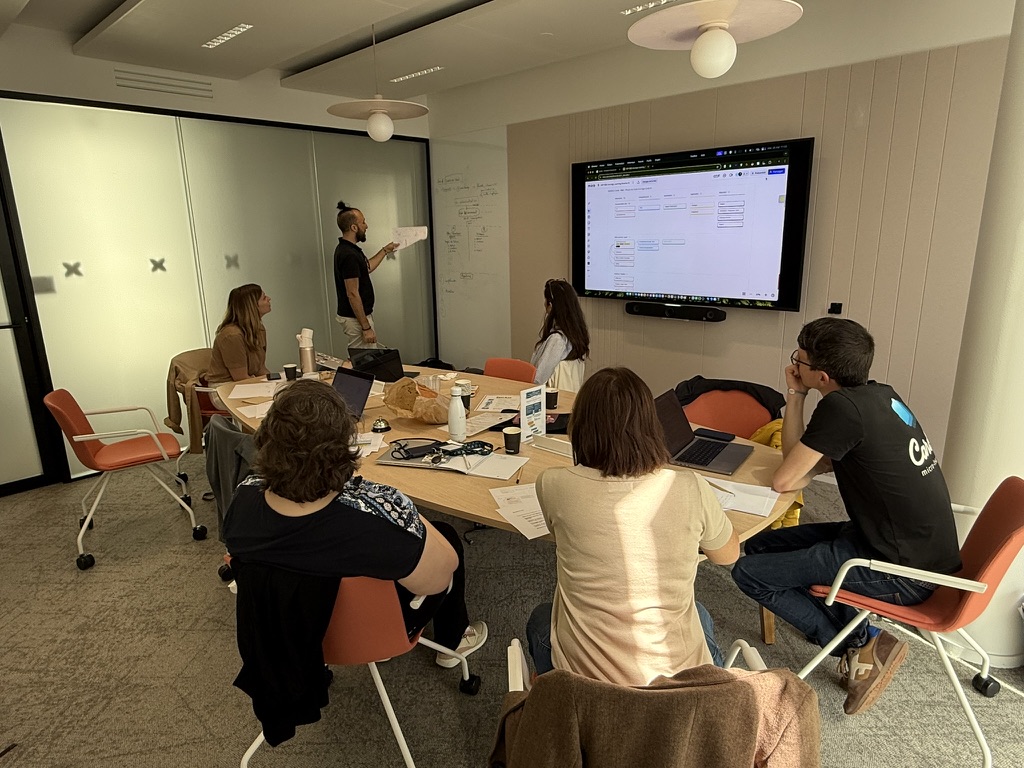
The Cards anchoring model works just as well for SMBs as for large groups. Circle 1 brought together 3 organizations of different sizes and had them compare their operational and strategic challenges.
The Naos group, the My English School franchise, and the My Learning Store organization joined the 1st Cards Circle dedicated to the impact and anchoring of their training and initiatives.


Cards microlearning combines low cognitive friction with high perceived value.
The discussions, facilitation, directions taken, and Learning Expeditions helped validate the fine-tuned fit between operational needs, targeted micro-behaviors and the formats proposed, strengthening learner buy-in and their lasting engagement in anchoring routines.
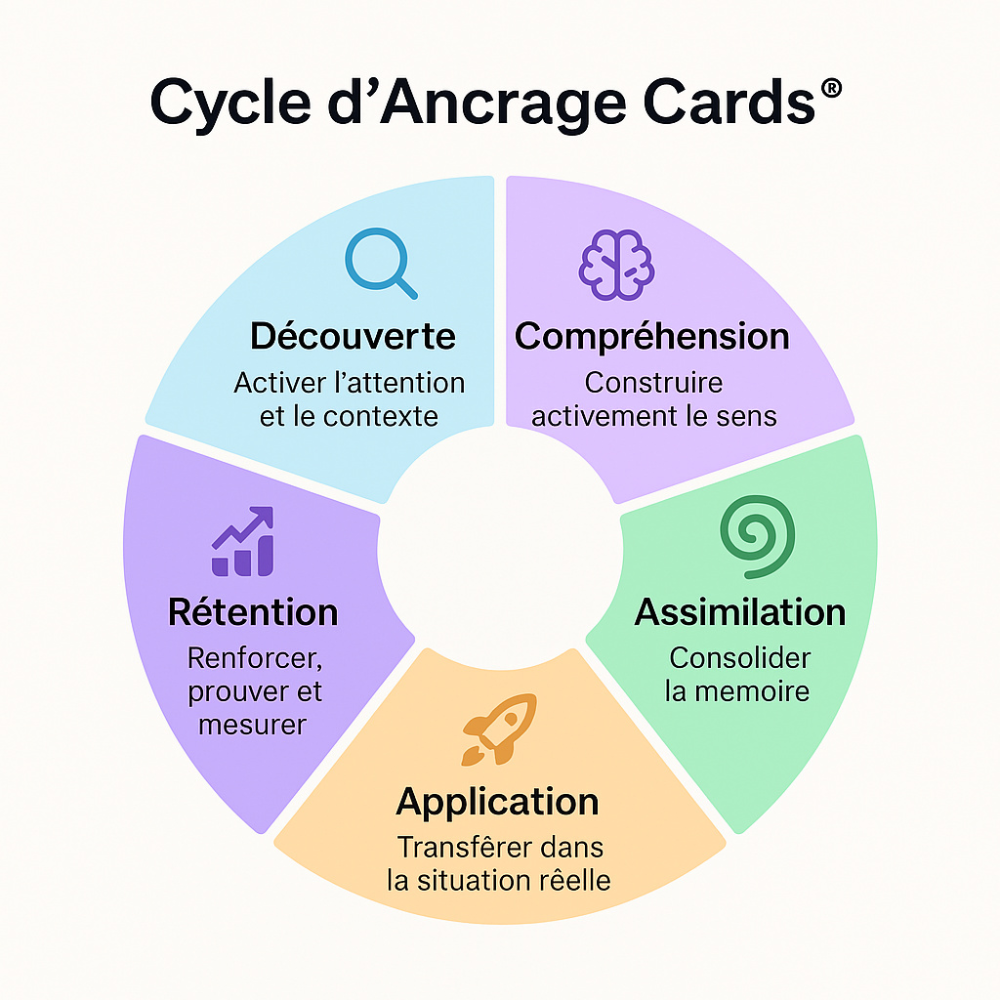
This cycle models the cognitive and behavioral stages observed in learners, from exposure to knowledge to its integration into operational routines.
It forms the framework used to read and measure the real impact of the Cards programs presented in this report.

plans
Toward an anchoring engine that's ever more adaptive, able to adjust formats, pace and reminders based on profiles, contexts and usage signals.
Better understand what anchors, what resists, and what drives performance, to steer programs with data instead of intuition.
Build sector programs and reference frameworks drawn from real-world use, impact retrospectives and partner expertise.